
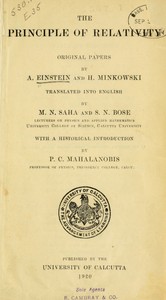
The Principle of Relativity by Albert Einstein and H. Minkowski
Let's be clear upfront: this is not a novel. There's no protagonist in the traditional sense, unless you count the human mind grappling with the universe. The 'plot' is the collision of two geniuses that reshaped physics.
The Story
The book collects the original, groundbreaking papers. First, you get Albert Einstein's 1905 paper on Special Relativity. He argues that the speed of light is constant for everyone, no matter how fast they're moving. This leads to wild conclusions: moving clocks tick slower, and moving objects shrink. Time and space aren't separate, absolute stages; they're relative to the observer.
Then, you get Hermann Minkowski's 1908 paper. He was Einstein's former professor. Reading Einstein's work, Minkowski had a flash of insight. He proposed that we shouldn't think of space and time as separate things. Instead, we live in a four-dimensional continuum he called 'spacetime.' In this view, every event is just a point in this four-dimensional block. This mathematical framework made Einstein's theory cleaner, more powerful, and visually stunning.
Why You Should Read It
You should read this not to become a physicist, but to witness a pivotal moment in human thought. There's a raw, creative energy here that's often polished out of textbooks. You see Einstein building his case with thought experiments about trains and lightning. Then, you see Minkowski reframing it all with the declaration, 'Henceforth space by itself, and time by itself, are doomed to fade away into mere shadows.' It's dramatic! Reading them together shows that scientific breakthroughs aren't always a single 'Eureka!' moment. Sometimes, it's a conversation—or a correction—between brilliant minds that fully unlocks an idea.
Final Verdict
This book is for the intellectually curious who aren't afraid of a little math. It's perfect for the science fan who has read popular explanations of relativity and wants to see the source code. It's also great for anyone interested in the history of ideas and how collaboration (even indirect, posthumous collaboration in Minkowski's case) drives progress. If you approach it patiently, not as a textbook but as a historical document, you'll come away with a deep appreciation for one of the most beautiful ideas ever conceived.
This work has been identified as being free of known copyright restrictions. Share knowledge freely with the world.
James Thomas
1 year agoWhile browsing through various academic sources, the wealth of information provided exceeds the average market standard. Truly a masterpiece of digital educational material.
William Thomas
9 months agoI started reading out of curiosity and the author's voice is distinct and makes complex topics easy to digest. Absolutely essential reading.
Karen Allen
1 year agoI had low expectations initially, however the atmosphere created is totally immersive. I will read more from this author.
Karen Martin
4 months agoA bit long but worth it.
Ashley Jones
2 years agoHaving followed this topic for years, I can say that the language used is precise without being overly academic or confusing. I'm glad I chose this over the other alternatives.