About 646 minutes
The Marriage of William Ashe — A Closer Reading
Relationships Society Historical Narratives
148,494 recorded words. 5 minutes difference from this book's estimate.
View Gutenberg source #14126
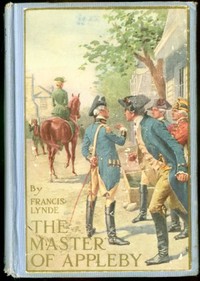
The Master of Appleby A Novel Tale Concerning Itself in Part with the Great Struggle in the Two Carolinas; but Chiefly with the Adventures Therein of Two Gentlemen Who — Key Ideas to Explore can be approached with a clearer sense of reading commitment from its source measurements: 147,246 words, 10 hr 41 min estimated reading time, and 17 detected text sections.
The text analysis averages about 20.5 words per sentence, while the detected sections provide another way to judge how the source is divided.
Project Gutenberg metadata also associates the work with “Historical fiction,” connecting these edition facts with the source record’s subject description.
Explore this collection
These alternatives are selected using recorded categories and estimated reading time.
About 646 minutes
Relationships Society Historical Narratives
148,494 recorded words. 5 minutes difference from this book's estimate.
View Gutenberg source #14126About 629 minutes
Relationships Society Historical Narratives
144,665 recorded words. 12 minutes difference from this book's estimate.
View Gutenberg source #19398About 606 minutes
Relationships Society Historical Narratives
139,240 recorded words. 35 minutes difference from this book's estimate.
View Gutenberg source #18721Search stored excerpts and compare books → Choose by your preferences →
Choices use stored catalog measurements. Estimates vary with reading speed. A shared category is a catalog label, not a claim that two books have the same argument or literary quality.
Search reads excerpt text stored with this catalog and links to its associated Gutenberg record. The connection is stored in the site database; this tool does not recheck that every excerpt is word-for-word identical to that external record. Excerpt search does not cover every chapter and does not verify historical publication dates.
Catalog snapshot checked: 2026-09-25. Coverage: 95 public books, 95 available source excerpts.
Read the complete public-domain text at its original source.
Read on Project GutenbergFrancis Lynde's The Master of Appleby opens with a first-person narrator, Richard Jennifer, who announces his intent in the very first chapter: 'I WHET MY FATHER'S SWORD.' The voice is courtly and deliberate, with a fondness for archaic phrasing—''Twas a dayfall to be marked with a white stone'—and a tendency to describe landscape in measured, painterly detail. The summer evening, the mountain-girt horizon, and the 'higher leaf plumes' are set down with a patient eye, suggesting a narrator who savors the scene even as he receives a challenge.
Yet the pace is not uniform. In the powder-magazine episode, the prose tightens: the description of the camp, the Indian dancers, and the stored powder becomes more urgent, and the narrator's internal conflict—between the desire to destroy the enemy and the need to protect 'my dear lady'—creates a sudden, focused tension. This shift from leisurely observation to compressed action is a key feature of Lynde's narrative strategy.
The excerpts reveal a narrator who alternates between two distinct voices. The first is that of a gentleman recalling events with a measured, almost antiquarian tone: 'The summer day was all but spent when Richard Jennifer, riding express, brought me Captain Falconnet's challenge.' This voice is fond of inverted syntax and formal constructions, as in 'Nay, nay, my dears, I would not have you think so lightly of my invention.' The second voice emerges in moments of crisis, when the prose becomes more direct and sensory: 'the bare sight of all the stored-up devastation set me athirst with a fierce longing for leave to snap a pistol.'
This dual register is not merely decorative. It signals a narrator who is both participant and retrospective storyteller, capable of stepping back to comment on his own actions. The shift from 'I came to attention and saluted in soldierly fashion' to the aside about 'the baronet-captain's lack of proper discipline' shows a mind that observes even as it acts. Readers may note how Lynde uses this technique to control the pace: the courtly voice slows time, while the urgent voice compresses it.
Lynde devotes considerable attention to the physical setting, but not merely for atmosphere. In the powder-magazine passage, the landscape is mapped with almost tactical precision: the savanna 'hedged about by the forest on three sides,' the stream dividing the camp from the hillside, the boulders 'fallen cleavings and hewings from the crags.' This detailed geography serves a narrative purpose: it establishes the spatial relationships that make the protagonist's secret mission—to reach the powder magazine and then the horses—both plausible and perilous.
The description also creates a visual contrast between the open, fire-lit camp and the shadowy hillside. The narrator notes that he is 'in plainest view from the great fire,' and the subsequent hail from Falconnet confirms the danger. This interplay of light and darkness, openness and concealment, mirrors the protagonist's own divided loyalties: he is among the enemy but acting for another cause. The landscape, in other words, becomes a stage for the central tension between visibility and secrecy.
The fifty-two chapter titles in The Master of Appleby form a distinctive narrative device. Many are phrased as first-person actions or experiences: 'I WHET MY FATHER'S SWORD,' 'I LOST WHAT I HAD NEVER GAINED,' 'I TASTE THE QUALITY OF MERCY.' Others summarize plot developments in a cryptic or proverbial style: 'A LIE WAS MADE THE VERY TRUTH,' 'A HATCHET SINGS A MAN TO SLEEP,' 'WE KEPT THE FEAST OF BITTER HERBS.'
These titles do more than label chapters. They create a rhythm of expectation and retrospection. The reader knows from the title 'I LOST WHAT I HAD NEVER GAINED' that a loss is coming, but not its nature; the title 'A GOLDEN KEY UNLOCKED A DOOR' promises a revelation without specifying the door. This technique encourages a reading experience that is both forward-looking and reflective, as each chapter's events are framed by the title's hint. The titles also reinforce the first-person perspective, making the narrative feel like a personal chronicle rather than an impersonal history.
Readers approaching The Master of Appleby may find it useful to attend to the narrator's shifts in register—from the courtly to the urgent—as signals of changing stakes. The detailed landscape descriptions reward careful reading, as they often encode the spatial logic of the plot. And the chapter titles, far from being mere labels, function as a kind of poetic summary that shapes the reader's expectations. Lynde's novel is a work of deliberate construction, and these elements offer a way into its particular rhythms.
Sometimes a story stays with me less for its battles than for its quiet moments—the way Francis Lynde lets a man’s voice shift from courtly to urgent, like weather turning. Reading The Master of Appleby reminded me of that same lingering feel in another old friend, The Calico Cat — Inside the Classic, where the pacing feels unhurried, almost secretive. It’s a comfort knowing some books simply wait.
Create a short personal record of your experience with this book.