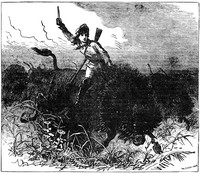
The Memoirs of Major Alexander Ramkins opens with a seventeen-year-old university student selling his books and furniture to join the Jacobite cause after the Battle of Gillycranky. The narrator’s voice is immediate and practical: he describes his “Noviceship in the Highlands” as a “proper Foundation” for the rough life to come. This is not a romanticized adventure; the language is blunt, the details concrete. The publisher’s preface frames the work as a cautionary tale, warning “true Britains” against foreign entanglements. Yet the narrative itself soon shifts from military action to a prolonged, almost novelistic episode in Lyons involving a robbery, a disguised footpad, and a clergyman’s generosity. The pace varies markedly, from the swift battle report to the leisurely, circumstantial account of the theft and its resolution.
A Soldier’s Abrupt Beginning
The memoir begins with a sudden decision: “I sold my Books and Furniture of my Lodgings, and equipp’d my self to observe the Martial Call.” The narrator is a “Stripling at the University of Aberdeen,” but the call to arms is immediate. The battle itself is mentioned only in passing—the “Field of Battle” is already over when he arrives. He joins “a broken Body of Men” retreating into the mountains. The language is terse, almost dismissive of the violence. The “Noviceship” he undergoes is described as a practical education, not a heroic ordeal. This opening establishes a voice that is matter-of-fact, even cynical, about military life. The reader is given no grand speeches or patriotic flourishes; instead, the focus is on the logistical reality of joining a losing cause.
The Lyons Robbery: A Set-Piece of Suspense
The longest sustained passage in the excerpts is a detailed account of a highway robbery near Lyons. The narrative slows dramatically, following an Englishman who is robbed, then returns to the city and spots the thief in a haberdasher’s shop. The description is precise: the thief’s “Silk Bag his Wigg was tied up in,” the “Box with little Roman Pieces” found on him. The scene unfolds with a lawyer’s attention to evidence—the innkeeper’s testimony, the suspect’s inability to account for his whereabouts. The narrator steps in to assist the Englishman, and the episode concludes with the thief likely facing execution “upon the Wheel.” This digression is notable for its pacing and detail, contrasting sharply with the compressed battle narrative. It suggests Defoe’s interest in criminal biography and legal procedure, and it gives the memoir a novelistic texture.
Camp Life and the Clergyman’s Temperance
Between the action, the memoir dwells on the tedium of camp life. The narrator observes that “when an Army is not upon Action, the Camp is a tedious Place,” especially for British subjects abroad. This reflection is followed by a dinner with an Irish Prebendary, who “wou’d not press his Wine upon us.” The narrator comments dryly: “he who urges the Glass too far, if he is not himself suspected of Insobriety, is certainly obnoxious to the immoral Part of the Ceremony.” The voice here is wry, almost essayistic. The clergyman is praised for his “Generous and Christian Temper,” but the praise is undercut by the soldier’s awareness of social performance. This section reveals the memoir’s hybrid nature: part adventure, part moral observation, part satire of manners. The pace is relaxed, the tone conversational.
The Memoirs of Major Alexander Ramkins rewards attention to its shifts in pace and voice. The narrator moves from the abruptness of a young recruit to the measured tone of a seasoned observer, capable of lingering over a robbery or a dinner. Readers should note how Defoe uses digression—the Lyons episode, the clergyman’s temperance—to build character and social commentary. The memoir is less a continuous adventure than a series of vignettes, each with its own rhythm. Approach it as a work of fictionalized experience, where the gaps between battles are as telling as the battles themselves.
Reading Ramkins’s weary chronicle of exile, I remembered my grandfather’s wartime letters—sparse, ironic, never sentimental. He’d have understood that bluff soldier’s tone. Then, oddly, I thought of Potash and Perlmutter Settle Things, whose own brisk, practical voice hides a similar ache for home. Both books whisper that wandering changes a person, quietly, permanently. That resonance felt less like discovery, more like an old, familiar ache surfacing. Potash and Perlmutter Settle Things — Edition Insights