About 234 minutes
Mr. Dooley: In the Hearts of His Countrymen — Themes and Context
Exploration Survival Adventure Tales
53,756 recorded words. 28 minutes difference from this book's estimate.
View Gutenberg source #13784

The catalog record for Bruvver Jim's Baby — A Reader’s Guide provides practical reading context through 47,152 words, 3 hr 26 min estimated reading time, and 5 detected text sections.
The text analysis averages about 16.6 words per sentence, while the detected sections provide another way to judge how the source is divided.
Project Gutenberg metadata also associates the work with “Western stories,” connecting these edition facts with the source record’s subject description.
Explore this collection
These alternatives are selected using recorded categories and estimated reading time.
About 234 minutes
Exploration Survival Adventure Tales
53,756 recorded words. 28 minutes difference from this book's estimate.
View Gutenberg source #13784About 168 minutes
Exploration Survival Adventure Tales
38,472 recorded words. 38 minutes difference from this book's estimate.
View Gutenberg source #14902About 137 minutes
Exploration Survival Adventure Tales
31,482 recorded words. 69 minutes difference from this book's estimate.
View Gutenberg source #14442Search stored excerpts and compare books → Choose by your preferences →
Choices use stored catalog measurements. Estimates vary with reading speed. A shared category is a catalog label, not a claim that two books have the same argument or literary quality.
Search reads excerpt text stored with this catalog and links to its associated Gutenberg record. The connection is stored in the site database; this tool does not recheck that every excerpt is word-for-word identical to that external record. Excerpt search does not cover every chapter and does not verify historical publication dates.
Catalog snapshot checked: 2026-09-25. Coverage: 95 public books, 95 available source excerpts.
Read the complete public-domain text at its original source.
Read on Project GutenbergThe catalog subjects for Bruvver Jim's Baby—Western stories, gold miners, foundlings, and Nevada—accurately signal the setting and core situation, but the excerpts reveal a narrative that dwells less on mining action and more on the social dynamics of a remote camp. The opening chapter, for instance, describes a Piute rabbit drive with a panoramic sweep: 'two hundred braves in number' marching 'some thirty yards apart' across a sage-brush valley. This is not a conventional Western shootout but a communal hunt, observed from a distance. The foundling, called Skeezucks, appears not in the first excerpt but is central to later passages, where the miner Jim's interactions with him dominate. The gold-mining subject is present mostly as a backdrop—Jim's claim is 'undeveloped and so far worthless'—and the real tension comes from storekeeper Parky's refusal to sell provisions, not from claim jumping or strikes.
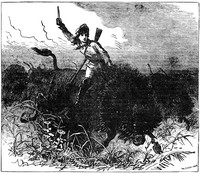
The novel opens not with a lone prospector but with a coordinated Piute rabbit drive, described in military terms: 'a firing-line of battle,' 'grim and inexorable as fate itself.' The line of hunters, 'red, yellow, and indigo in their blankets,' stretches over two miles. This set piece is the most visually elaborate scene in the excerpts, and it establishes a Nevada landscape that is both vast and harsh. The rabbits are 'panic-stricken,' and the ponies carry 'great white burdens of the slaughtered hares.' Yet the focus quickly narrows to a 'tiny little pony-rider' who is 'apparently not more than thre'—the text breaks off, but the child is clearly an outsider to the hunt. This opening suggests that the book will balance broad frontier spectacle with intimate character study, though the excerpts provide no further Piute presence after Chapter I.
Later excerpts shift to Jim's struggle to obtain food. The storekeeper Parky refuses credit, and Jim responds with sardonic drawls: 'There's only one time of day when it's safe to deal with a gambler, and that's thirteen o'clock.' His pride surfaces in refusals of charity, but the blacksmith Webber orchestrates a covert supply run. The dialogue is thick with period idiom—'slick as a lead two-bits,' 'you rich fellers want to run the whole shebang'—and the tension is economic, not violent. Jim's repeated phrase 'If only I had the resolution' becomes a refrain, undercut by his inaction: he 'touched no tools' and instead tells stories to Skeezucks. The camp's social hierarchy is clear: Parky hoards goods, Webber mediates, and Jim survives on goodwill. The catalog subject 'gold miners' is thus less about mining than about the miner's marginal status.
The foundling Skeezucks is the emotional center of the later excerpts, though the text never describes his appearance or origin. Jim takes him 'on his knee' and tells 'tales the little fellow seemed most to enjoy.' The child's name—a phonetic spelling of 'skeezucks,' slang for a small or pitiful person—suggests a blend of affection and condescension. The excerpts show Jim more concerned with the boy's welfare than with his own claim: he lists needed provisions as 'condensed milk and a slab of bacon and a sack of flour and a bean or two and a little 'baccy,' with the milk first. The Christmas chapters hinted in the table of contents (XI–XIII) are not excerpted, but the buildup involves Webber hiding the store's confiscation of half the supplies. The foundling subject thus drives the plot's moral stakes, even as the mining subject remains dormant.
Readers should note that the excerpts cover only the first quarter of the novel (Chapters I–XIV out of XXIII). The catalog subjects are reliable as entry points, but the actual narrative emphasizes community friction and domestic care over action. Pay attention to the rhythm of Jim's speech—his drawled 'if only' and his refusal of help—as a key to his character. The Piute opening may not recur; the story likely stays within the camp. Approach the book as a character study set in a mining town, not a thriller of gold and guns.
What stayed with me about Bruvver Jim's Baby was how quietly a rough miner’s heart rearranges itself around a small, helpless life—no grand speeches, just the daily doing. That same tenderness lives in From the Valley of the Missing — Reading Notes, where absence teaches a softer way of holding on. I think of both on gray afternoons.
Save your reaction, strongest insight, and memorable passage.