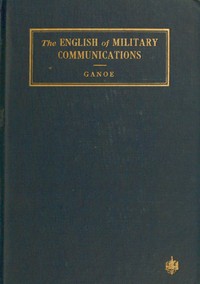
The English of military communications by William Addleman Ganoe
Forget what you think you know about military history books. The English of Military Communications isn't about grand strategy or heroic charges. It's about something much more fundamental: how to talk so that people don't die. William Addleman Ganoe, a career officer, tracks the evolution of military language from the early 1900s through World War II. He shows us a system struggling to keep up. As armies grew larger and technology like the radio sped everything up, a confusing order could lead to disaster. The book is filled with real examples—vague telegrams that sent troops to the wrong place, poorly written manuals that left mechanics baffled.
The Story
Ganoe doesn't present a single narrative plot. Instead, he builds a case, chapter by chapter, showing the U.S. military's long, messy fight for clear communication. He starts with the problems: the wordy, old-fashioned prose of the past. Then, he walks us through the solutions—the creation of standard formats, the ruthless cutting of unnecessary words, the birth of that distinct, no-nonsense 'military style.' He argues that this wasn't just about efficiency; it was about building a common brain for a massive organization. When every report uses the same structure and every order avoids fancy language, misunderstandings drop, and things get done.
Why You Should Read It
Here's the surprising part: this book makes you look at everyday language differently. You start to see the 'military style' everywhere—in software documentation, safety manuals, and even IKEA assembly instructions. Ganoe's passion is clear. He wasn't just a historian; he was a soldier who lived through the consequences of bad writing. His insights feel earned. You come away with a deep appreciation for the sheer, hard work behind clarity. It turns what seems like dry bureaucracy into a compelling story of human problem-solving.
Final Verdict
This isn't for everyone. If you want battle scenes, look elsewhere. But if you're curious about language, history, or how large organizations actually function, this is a hidden gem. It's perfect for writers interested in precision, history buffs who enjoy social history, or anyone who's ever had to write an email they knew absolutely had to be understood. It's a short, smart read that changes how you hear the world.
This historical work is free of copyright protections. Enjoy reading and sharing without restrictions.
Michael Robinson
6 months agoI have to admit, the arguments are well-supported by credible references. One of the best books I've read this year.
Barbara Jackson
1 year agoA must-have for anyone studying this subject.
Logan Jackson
10 months agoFast paced, good book.
Liam Sanchez
1 year agoWithout a doubt, the storytelling feels authentic and emotionally grounded. One of the best books I've read this year.





Patricia Miller
2 years agoI particularly value the technical accuracy maintained throughout.