
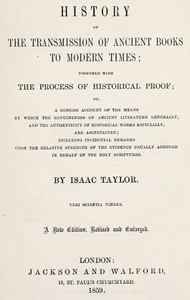
History of the transmission of ancient books to modern times by Isaac Taylor
Isaac Taylor's book isn't a straight history of ideas. Instead, it's the biography of the books themselves. He tracks how ancient texts, from Greek philosophy to early Christian writings, physically survived from the ancient world into the modern era.
The Story
Taylor starts in the ancient world, where books were handwritten on papyrus scrolls—incredibly fragile and rare. He walks us through the massive threats they faced: the collapse of the Roman Empire, the loss of central libraries, and the simple fact that copying a book by hand was a monumental task. The narrative then follows the thread of preservation into the Middle Ages, where monasteries became the unexpected fortresses for knowledge. Monks meticulously copied texts, not just religious ones, but works of science, history, and literature that might otherwise have been lost forever. The story culminates with the invention of the printing press, which changed the game entirely, allowing books to be reproduced and spread in ways previously unimaginable.
Why You Should Read It
What grabbed me was the sense of fragile contingency. Taylor makes you feel the sheer luck and stubborn effort involved in getting a single ancient text to the 1800s. It reframes history. You stop thinking about 'Plato' as just a name and start thinking about the specific, probably grumpy, medieval monk who spent a year hunched over a desk, hand-cramping as he copied The Republic by candlelight, saving it for us. It’s a powerful reminder that our connection to the past isn't automatic; it's a chain of human effort, full of near-misses and close calls.
Final Verdict
This is a perfect pick for curious readers who love history but want to see it from a new angle. It’s not a dry academic text; it's a story of resilience. You'll appreciate it if you've ever geeked out in a used bookstore, wondered about the origins of a favorite classic, or just love a good survival tale. Fair warning: it's a 19th-century book, so the prose has a older rhythm. But push through that, and you'll find a genuinely thrilling account of how the words of the past literally made it to our hands.
The copyright for this book has expired, making it public property. Knowledge should be free and accessible.
Mark Harris
1 year agoThe fonts used are very comfortable for long reading sessions.
Robert Ramirez
8 months agoJust what I was looking for.
Barbara Harris
1 year agoWithout a doubt, the character development leaves a lasting impact. Don't hesitate to start reading.
William Davis
8 months agoI stumbled upon this title and the narrative structure is incredibly compelling. Truly inspiring.



Jackson Johnson
1 year agoFive stars!