
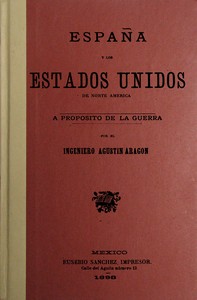
España y los Estados Unidos de Norte América : a propósito de la guerra by Aragón
Published in the immediate aftermath of the Spanish-American War in 1898, this book is less a formal history and more a passionate defense. Written by Agustín Aragón, a Spanish intellectual and diplomat, it's Spain's side of the story, told while the wounds were still fresh.
The Story
There isn't a plot in the traditional sense. Instead, Aragón builds an argument. He walks through the events leading to the war—the explosion of the USS Maine in Havana harbor, the American media's sensationalist "yellow journalism," and the political pressures in Washington. His core point is that Spain was wronged. He claims Spain was willing to negotiate and make concessions for Cuba, but the United States, driven by expansionist ambitions and a biased press, rushed into a war Spain never wanted. He portrays Spain as a civilized European power unfairly cast as a brutal oppressor by a younger, more aggressive nation. The book is his attempt to set the record straight for an international audience, to salvage Spanish honor after a swift and decisive military loss.
Why You Should Read It
Reading this is a masterclass in perspective. American history often paints the 1898 war as a noble, quick intervention. Aragón's writing flips that script entirely. You feel his frustration and national humiliation. It’s a reminder that history is never just one story. His arguments about media influence and public opinion feel eerily modern. You don't have to agree with him (and you likely won't on many points) to be gripped by his fervor. It’s the voice of a proud empire in decline, trying to make sense of a new world order where it is no longer a top player. The emotional charge is what makes it compelling, not dry facts.
Final Verdict
This is not for someone looking for a balanced, introductory history of the Spanish-American War. It's a primary source, a historical artifact. It's perfect for history buffs who already know the basic timeline and want to dive into the contemporary reactions and emotions. It's also great for anyone interested in propaganda, media studies, or the psychology of national defeat. Think of it as a time capsule of Spanish pride and pain. You'll come away with a much messier, more complicated understanding of 1898, and that's a good thing.
This work has been identified as being free of known copyright restrictions. Access is open to everyone around the world.
Robert Lee
1 year agoSimply put, the content flows smoothly from one chapter to the next. I couldn't put it down.
Mark Wilson
1 year agoComprehensive and well-researched.
Joseph Smith
10 months agoEnjoyed every page.
Charles Flores
1 year agoVery helpful, thanks.







Matthew Jones
1 year agoText is crisp, making it easy to focus.